The Iron Industry, Farmland, and Local Visionaries Behind the University’s Beginnings in Centre County
By Christopher Blue
The furnaces, they painted the sky blue with the billowing smoke of those charcoal fires, creating the iconic blue and white that became Penn State’s colors.
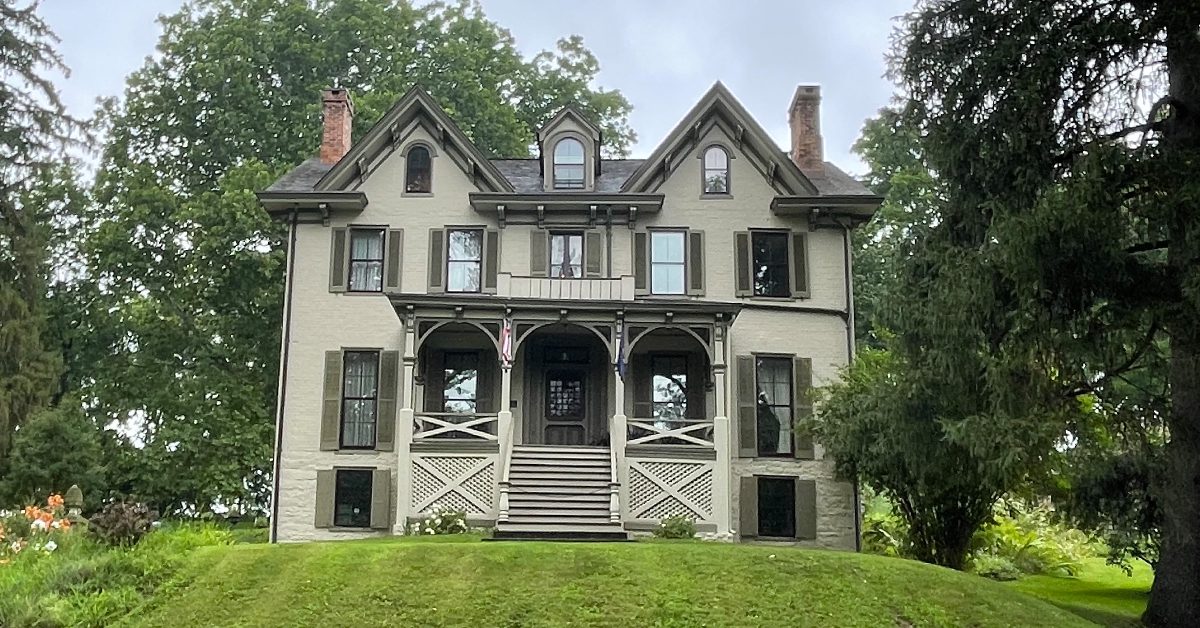
Located near Penn State’s main campus, down the hill from the Bryce Jordan Center along the route thousands of fans travel after a Saturday afternoon football game at West Shore Home Field at Beaver Stadium — whether they’re headed to Happy Valley Casino to follow the devil on their shoulder, Barnes & Noble for a relaxing read, Quaker Steak & Lube for a bite to eat, or just heading home — stands that big house we’ve all noticed, wondered about, and assumed was either abandoned and left to rot or simply another forgotten piece of Centre County history we never took the time to learn about.
Forgotten? No. A piece of Centre County history we never knew about? Yes.
History, indeed, and it is still very much being preserved and very much in use.
The tree-shaded, 28-room mansion that makes its presence known just off Route 26 is, in fact, home to the Centre County Historical Society and is recognized as the birthplace of Penn State University.
The Centre County Historical Society continues to preserve the history and heritage of the region and the building to this day.
Pennsylvania’s iron furnaces helped forge not only the state’s early history but also the foundation of Penn State’s main campus in State College.
In 1791, Revolutionary War veterans Gen. Samuel Miles and Col. John Patton established Centre Furnace after recognizing the abundance of natural resources throughout Centre County and the surrounding region. Their enterprise helped develop Centre County’s iron industry.
The surviving furnace stack — the large, truncated stone pyramid that now stands in stately semi-ruin near Centre Furnace Mansion — remains a visible reminder of that history.
The county’s history was shaped by the hard work required to operate Centre Furnace, the region’s first charcoal iron furnace.
The industry fueled the local economy and contributed to the area’s growth by producing useful, long-lasting tools used in everyday life.
Ironworkers forged axes and plowshares used to clear land, cultivate fields, and support farming and transportation. Iron kettles and pots were used for cooking, washing, and many other daily household tasks.
Iron furnaces also produced cannons and cannonballs for military use.
Household tools we take for granted today, such as pumps and stoves, were eventually produced at the iron furnaces for use not only in homes but also in businesses and cabins.
During the peak of ironmaking, the furnaces were an integral part of Centre County’s early history, with numerous iron furnaces operating throughout Pennsylvania.
The region’s ironmaking heritage extends beyond Centre Furnace to other important historic sites.
Another significant site is Curtin Village at Eagle Iron Works, home to the ironmaster’s mansion, the waterwheel-powered furnace complex, the workers’ village, the Chesapeake and Ohio Railway caboose displayed out front, and the railroad car used by Civil War Gov. Andrew Gregg Curtin.
More than six decades later, Centre Furnace ironmasters James Irvin and Moses Thompson helped bring the Farmers’ High School of Pennsylvania to Centre County.
In 1855, they offered 200 acres of Centre Furnace land for the new agricultural school.
Centre Furnace Mansion hosted the site-selection gathering, and the agreement establishing the school’s location is believed to have been signed in its east front parlor.
The institution eventually became Penn State.
The Centre County Historical Society provides regular educational tours about the history of the building, the furnaces, and the region’s early years every Wednesday, Friday, and Sunday from 1 to 4 p.m.
Wonder no more: Book a tour and discover what shaped the town you live in and the grounds you walk through every day with the Historical Society’s tours at Centre Furnace Mansion.
What Is a Charcoal Furnace, and What Did It Take to Operate One?
The hustle and bustle of a once-thriving industry has now quietly retired with the passage of time.
Operating the furnaces, however, required workers to overcome constant logistical hurdles. Innovation and ingenuity made the ironmaking process more efficient, but operating a charcoal furnace still demanded significant labor, time, and natural resources.
The furnaces were built into the sides of hills, allowing workers to dump alternating layers of natural material — ore, charcoal, and, in many cases, limestone — into their open stacks.
At the bottom, blasts of air were pumped through metal pipes by huge bellows powered by waterwheels.
Though less common today, waterwheels still exist.
A waterwheel is a simple machine that converts the energy of moving or falling water into useful power. It consists of a large wheel with blades, paddles, or buckets attached to its outer edge.
Waterwheels were often built with wood, one of central Pennsylvania’s most valuable resources. Essential to the operation of iron furnaces, the wheels were powered by the flow of nearby brooks and creeks and drove the enormous bellows that forced blasts of air into the furnaces.
At Centre Furnace, water from Willy Brook, now known as Thompson Run, powered the waterwheel and bellows.
Wood was also essential to construction and daily life. It was used to build structures that made it easier to access and transport materials and resources.
Perhaps its most important use, however, was its transformation into charcoal.
Because wood itself did not produce the sustained, intense heat required to smelt iron efficiently, trees were cut down and slowly burned in covered earthen mounds by colliers.
This process created charcoal, a nearly pure form of carbon capable of producing the intense heat required for ironmaking and fueling the furnaces.
What didn’t benefit the ironworkers, though, was the constant struggle to overcome the hurdles that made growth difficult.
One of the biggest challenges was transporting iron to profitable markets. The cost per ton of transporting iron was high, limiting access to more distant markets.
Horse-drawn wagons hauled natural materials such as ore, limestone, and charcoal — essential ingredients in the ironmaking process — across difficult terrain to the Centre County furnaces.
The cost and difficulty of transportation limited the quantity of materials that could be delivered to the region’s furnaces, where they were transformed into the many useful tools and products that helped build early Pennsylvania.
The Wealth and Land Associated With Centre Furnace Eventually Helped Connect the Iron Industry to the Institution That Became Penn State.
After a donation of 200 acres helped secure its location, the Farmers’ High School of Pennsylvania was established in Centre County in 1855, with instruction beginning in 1859.
Founding President Evan Pugh drew on the scientific education he received in Europe to develop a curriculum that combined theoretical studies with practical applications.
Classes originally took place in the unfinished Old Main, which became the campus’s primary building, housing classrooms, student residences, administrative offices, and other university facilities.
When Penn State President George Atherton arrived in 1882, there were only 87 students, and the institution had rarely awarded more than a half-dozen degrees in any given year.
Old Main Remains a Visible Connection Between Penn State’s Agricultural Beginnings and the University It Is Today.
Old Main, built in 1930, is the iconic administrative center of Penn State’s University Park campus. It houses the president’s office and features the famous Land-Grant Frescoes and bell tower.
The original limestone building, first occupied in 1859 and completed in 1863, once served as the center of the institution, housing classrooms, a chapel, dining facilities, and student dormitories.
After developing serious structural issues, it was torn down in 1929.
The current Federal Revival-style building was erected in 1930 using much of the original, locally quarried limestone.
With a foundation built upon agriculture, ironworkers and farmers helped build Penn State, the Centre County region, and a lasting Pennsylvania legacy. Today, the area’s surrounding farms — many of which are open to visitors — and its imposing surviving furnace stacks demonstrate how the past remains an important part of the present. Although some of the furnace stacks still stand, the furnaces are no longer in operation, as easier and more efficient methods replaced the old ways of producing the materials and tools that once sustained everyday life.
Modern-day Penn State’s location and development are closely connected to the foundation laid by Centre Furnace. The wealth and land associated with the iron operation allowed James Irvin and Moses Thompson to help secure the agricultural school’s location in Centre County. The institution then educated generations of students in the scientific knowledge and practical skills needed to succeed in agriculture. T&G
Christopher Blue is a freelance writer in State College.